Are you or a loved one searching for a trusted sober living program? Give us a call!  310-953-4075
310-953-4075 310-953-4075 Getting sober can change more than what you drink or use. It can also change how you spend your evenings, weekends, and free time.
If drinking or using was once part of your social life, relaxing, or simply filling a few empty hours, you may eventually find yourself wondering: What am I supposed to do now?
The answer doesn't have to be a packed schedule or a brand-new personality. Sometimes it's as simple as trying something you haven't done before, making plans with people you enjoy, or finding a few small things that make an ordinary Saturday feel different.
You know that thing you've been saying you'll try “one day”?
This could be the time.
Take a cooking class. Try pottery. Learn photography. Pick up a guitar. Take a dance class. Try rock climbing. Learn how to make something you've always bought instead of made yourself.
It doesn't have to become your new passion. Sometimes trying something once is enough to discover that you like it.
A little friendly competition can make an ordinary afternoon much more interesting.
Try bowling, mini golf, a recreational sports league, pool, cards, video games, or a board game with friends.
And don't take it too seriously. Losing spectacularly at something can still make for a pretty good night.
Not everything you do needs to be productive.
Cook something you've never made. Put together a playlist. Take photos around your neighborhood. Paint, draw, write, build something, or try a craft.
Creative activities can also give you something to focus on while you figure out what you genuinely enjoy doing with your time.
Not every social activity has to happen in a bar.
Go to a movie, comedy show, concert, museum, sporting event, restaurant, or local event. Try a new café or find a place you've never eaten before.
You may be surprised by how many things you've overlooked because drinking used to be the main event.
You don't need to book a flight to feel like you're somewhere new.
Pick a neighborhood you've never explored. Visit a farmers' market, bookstore, park, museum, or restaurant. Take a different route and see where it leads.
Even better, bring someone along and make a day of it.
Sometimes the activity matters less than who you're doing it with.
Invite a few friends over for dinner. Have a movie night. Order takeout and play cards. Cook together. Have a ridiculous board-game competition.
The point isn't to recreate your old social life without alcohol. It's to create new memories that don't depend on it.
Some activities are fun because they give you something to look forward to. Others are fun because you completely lose track of time while doing them.
Try something you can return to regularly, whether that's gaming, reading, photography, cooking, music, gardening, fitness, or collecting something you're genuinely interested in.
You don't need to be good at it. You just need to enjoy doing it.
Fun doesn't always mean entertainment.
Volunteer at a local organization. Help a friend with a project. Cook dinner for someone. Get involved in a community activity. Spend an afternoon helping someone who could use an extra hand.
Doing something for someone else can also give an otherwise ordinary day a sense of purpose.
Not every plan needs to be scheduled three weeks in advance.
If someone asks you to grab coffee, go bowling, check out a new restaurant, or take a drive somewhere you've never been, consider saying yes.
Of course, you don't have to say yes to everything. But permitting yourself to be spontaneous can make life feel a little less predictable.
You don't need one huge event to make a weekend feel good.
Maybe Friday is dinner and a movie. Saturday is a morning workout, lunch somewhere new, and a game night. Sunday is coffee, a walk, and some time to yourself.
The details don't matter as much as having something in your week that you genuinely look forward to.
Sometimes boredom isn't really the problem. Decision fatigue is.
You have free time, but suddenly every option feels like effort. Go out? Stay in? Watch something? Call someone? Try a hobby? By the time you've considered everything, you end up doing nothing.
That's where Sober Bingo comes in.
Pick a square, give it a try, and see where it takes you.
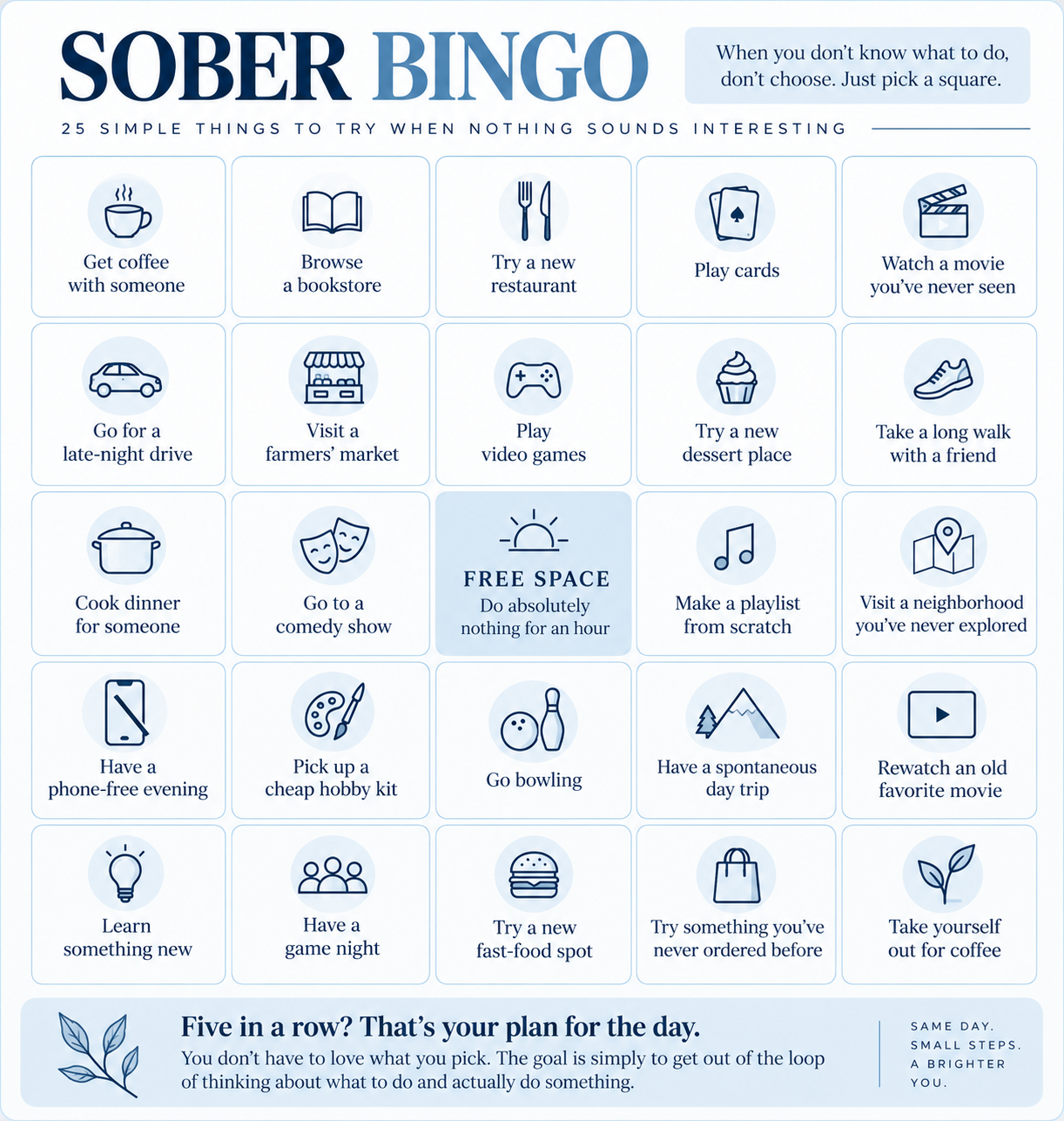
Five in a row? Bingo.
And if you try something and hate it, that's okay too. Cross it off and move on. Finding your kind of fun takes a little experimenting.
This can happen.
In early sobriety, things that used to feel exciting may suddenly seem ordinary. You may try a new activity and think, “That's it?” Or you may not feel interested in doing much of anything.
You don't have to force yourself to love every activity. Start small and give yourself room to experiment.
If you continue to feel uninterested in almost everything you once enjoyed, especially alongside persistent sadness or other changes in your mood, consider talking with a mental health professional.
Sobriety can change your social life, particularly if many of your old plans revolved around drinking or using.
That can be difficult, but it can also allow you to build friendships around things you actually enjoy.
You might discover that your ideal Friday night is dinner with two close friends, playing video games until midnight, watching a terrible movie together, or going somewhere none of you have been before.
You don't need a huge social circle. A few people you can genuinely enjoy spending time with can make a big difference.
Start by changing the setting and the activity. Go for dinner, see a movie, attend a concert, play a game, explore somewhere new, or plan an activity with friends. Fun doesn't have to involve drinking to make the experience enjoyable.
You could cook together, play cards or board games, go bowling, see a movie, try a new restaurant, explore your city, attend a sporting event, or simply hang out somewhere you feel comfortable.
Make a plan before Friday arrives. Try dinner, a movie, gaming, a fitness class, a comedy show, a late-night coffee, or a low-key night with friends. You don't need to fill every hour, but having something to look forward to can make the evening easier.
If drinking or using was a major source of entertainment, free time can initially feel unfamiliar or empty without it. It can take time to discover new interests and routines.
Having a substance-free place to live can give you room to establish new routines, spend time with others, and focus on the next part of your recovery.
Bridges Sober Living Apartments offers non-clinical sober living in Los Angeles for people continuing their recovery in a substance-free environment.