 Call Us
Have Questions About Medication Monitoring?
If you are considering Bridges and want to understand how medication monitoring fits into the sober living environment, contact us to discuss your situation and the procedures that may apply.
 310-953-4075
At Bridges Sober Living Apartments, medication monitoring is available as part of the structure provided within our sober living environment. The service is designed to give residents additional oversight around their existing medication routines while they continue living in sober housing.
Medication monitoring does not replace medical care or medication management from a licensed healthcare provider. Residents remain responsible for following the instructions provided by their prescribing provider.
Disclaimer: Medication monitoring at Bridges is a non-clinical sober living service. It does not constitute medical care, medical advice, or medication management. Bridges does not prescribe or make changes to medications. Residents should direct questions about medications, dosage, side effects, or treatment decisions to their prescribing healthcare provider.

Taking medication consistently can be difficult when someone is adjusting to a new routine after treatment or managing multiple responsibilities.
Medication monitoring provides an additional layer of structure within the sober living environment.
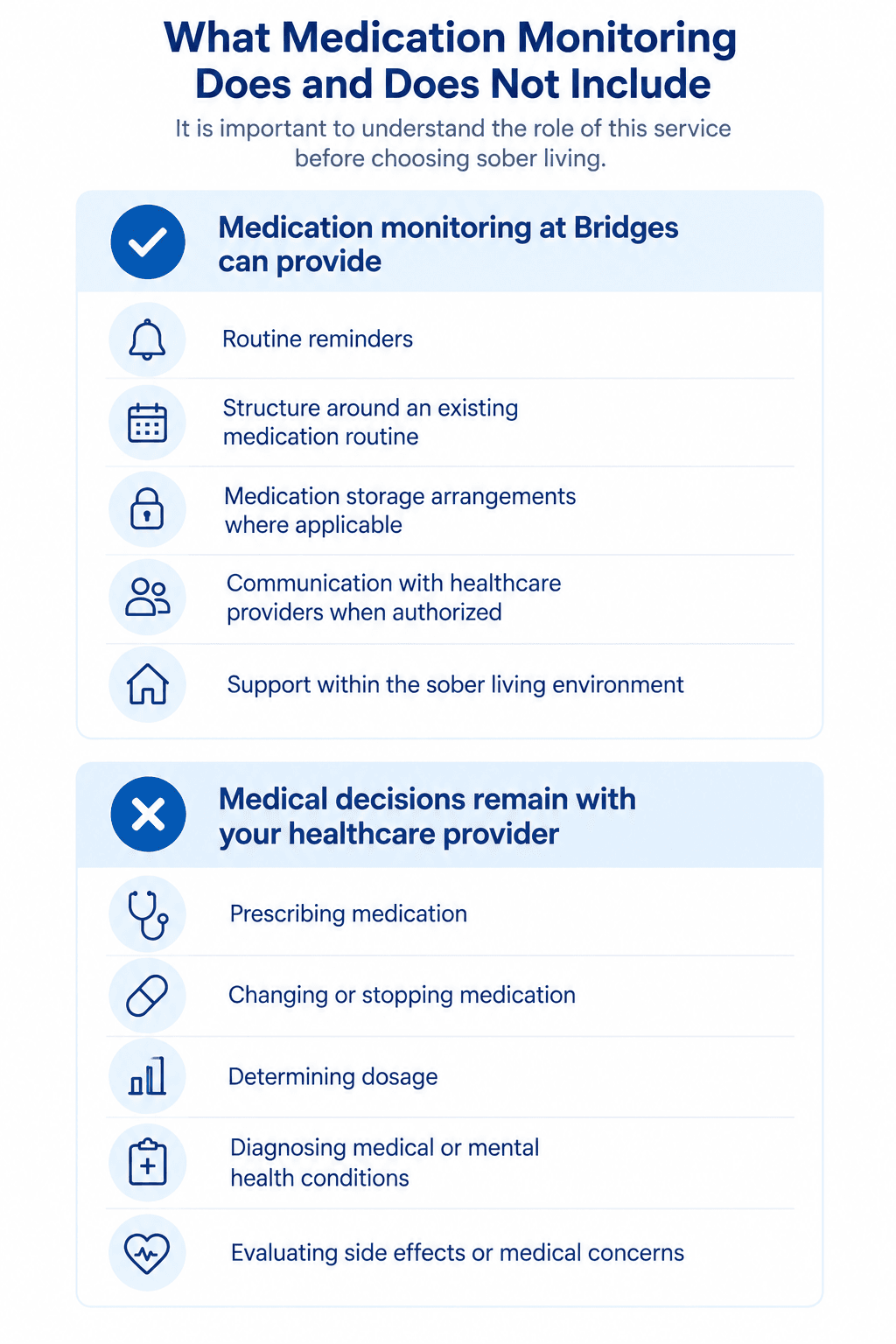
Depending on the resident's circumstances and the arrangements available at the residence, monitoring may involve:
The purpose is not to make medical decisions. It is to provide structure around the medication routine that has already been established by the resident and their healthcare provider.

Medication monitoring may be worth considering if you are entering sober living and would prefer additional structure around your existing prescriptions.
It may be relevant for residents who:
Having a prescription does not automatically mean that medication monitoring is necessary. The appropriate arrangement depends on the resident, the residence's policies, and the instructions of the prescribing provider.
The specific support provided depends on the resident's circumstances and the arrangements at the residence.
Residents may receive reminders or other routine-based support related to taking medications according to the schedule established by their healthcare provider.
The role of Bridges is to provide structure around the routine—not to determine what medication a resident should take, how much they should take, or when their prescription should be changed.
Medication storage arrangements may be available where appropriate. Residents can discuss storage procedures, access, and related expectations with Bridges before moving in.
When appropriate authorization is provided, Bridges may communicate with a resident's existing healthcare providers regarding information relevant to the sober living arrangement.
Any decisions about prescriptions, dosage, medication changes, side effects, or treatment remain with the resident and their licensed healthcare provider.
Medication monitoring takes place within the broader sober living environment. Residents continue managing their daily responsibilities while following the medication instructions provided by their healthcare professionals.
If medication monitoring is part of your sober living arrangement, the process can be discussed as part of getting started with Bridges.





You may want to ask about medication monitoring if you are considering sober living and know that you would benefit from additional structure around an existing medication routine.
You do not need to make that decision on your own before contacting Bridges. During the intake process, you can explain your situation, ask how medication-related procedures work, and find out what options may be available to you.
If your main concern is whether a particular medication is appropriate, whether your prescription should change, or what to do about a medical issue, that conversation should be with your prescribing provider.
If you are considering Bridges and want to understand how medication monitoring fits into the sober living environment, contact us to discuss your situation and the procedures that may apply.
 Contact Bridges to Learn More