Are you or a loved one searching for a trusted sober living program? Give us a call!  310-953-4075
310-953-4075 310-953-4075 
Getting help usually happens in stages. You may first realize something is wrong, then tell someone, call a professional, and eventually begin care. That process can take weeks, months, or even years, and the timeline often differs for men and women.
Bridges Sober Living surveyed 1,011 adults who have lived through a substance use or mental health crisis about their experiences with seeking care. They shared what led up to the crisis, how long every step took, who they turned to, and what finally pushed them to seek help. Here's what they told us.
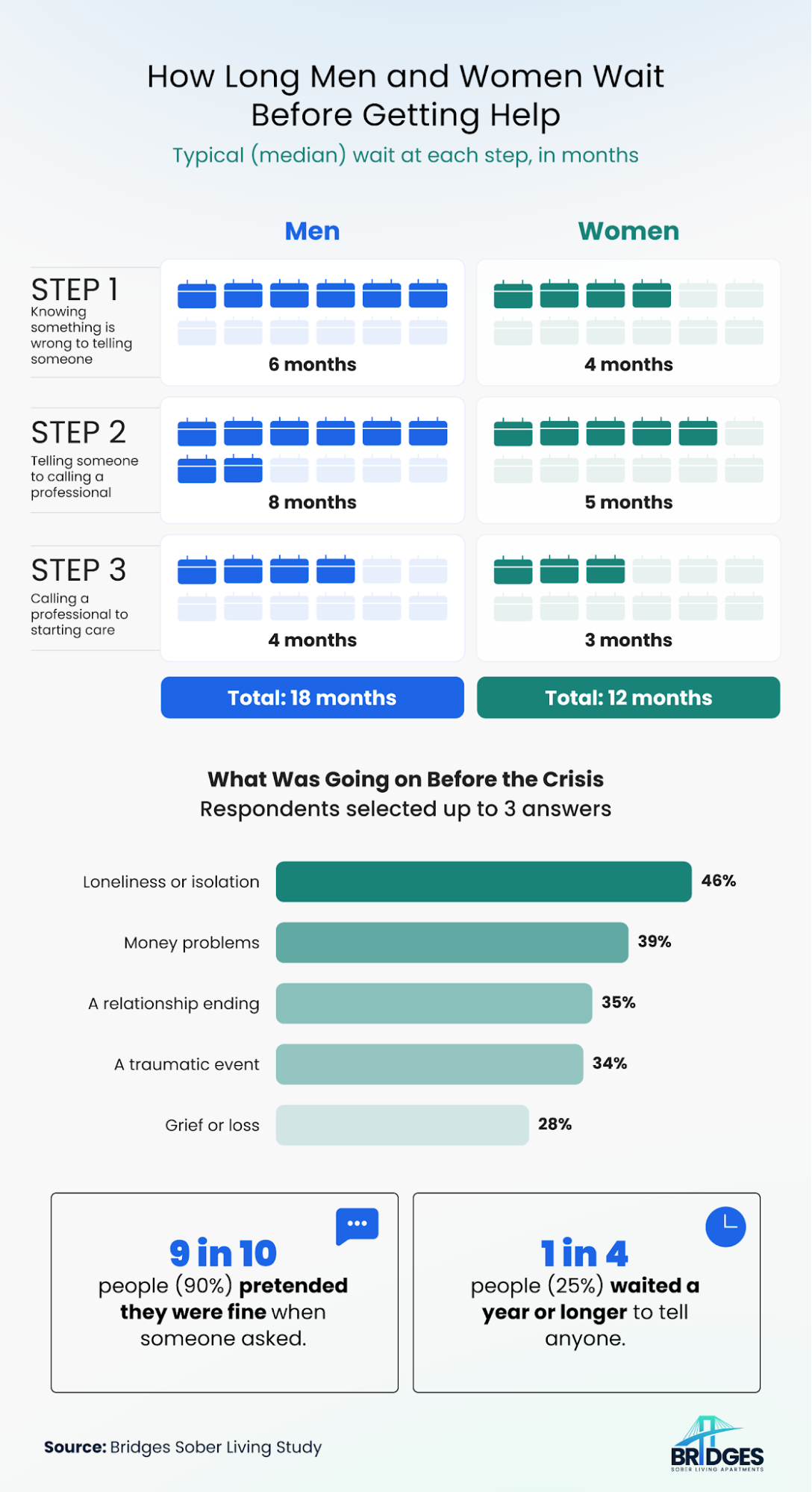
The typical person who has lived through a mental health or substance use crisis waits about 4 months before telling anyone they are struggling.
1 in 4 people (25%) waited a year or longer before telling anyone they were going through a mental health or substance use crisis.
The typical man's road to care takes about 18 months, while the typical woman's takes about 12 months.
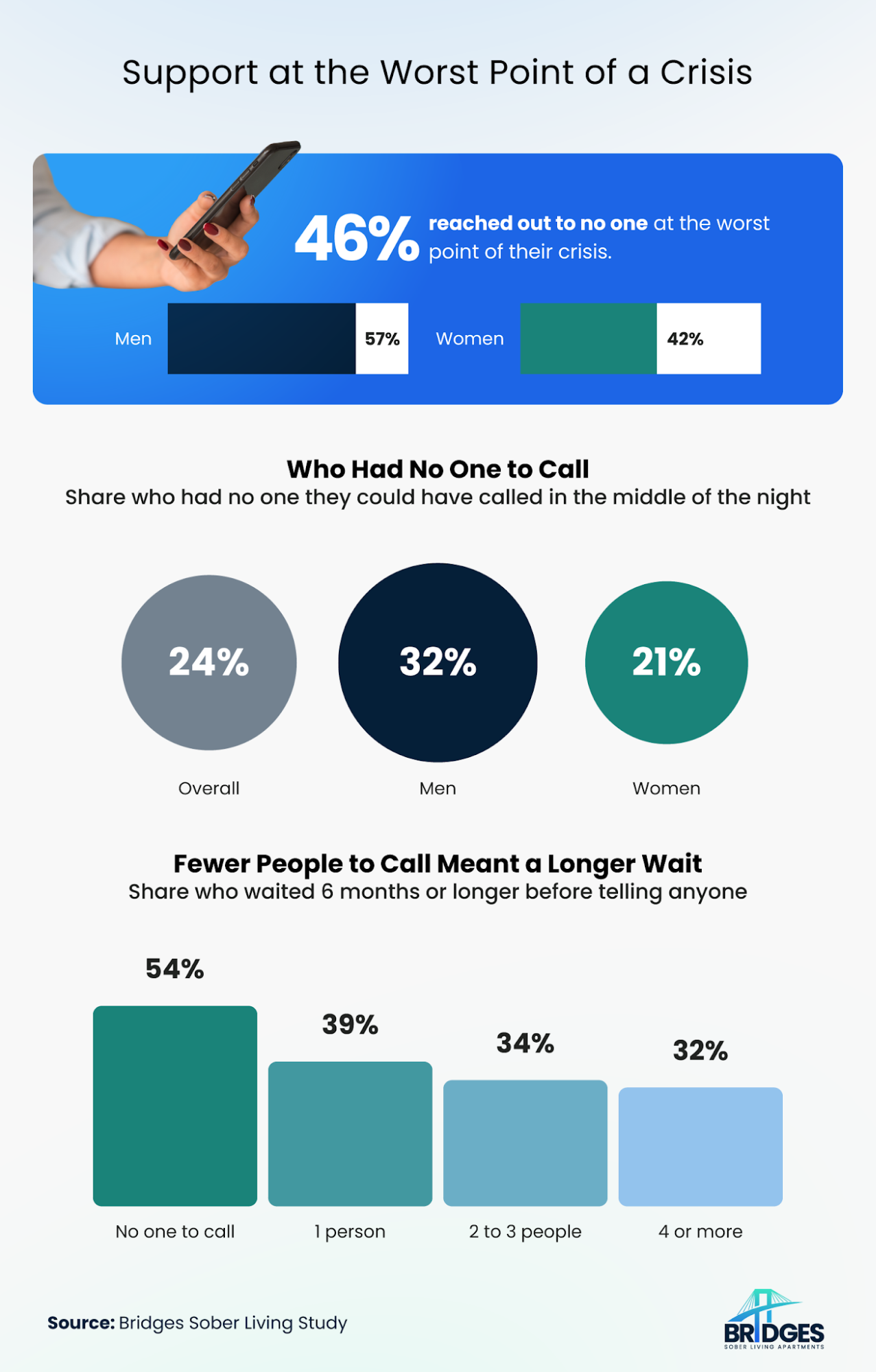
Nearly half of the people who have been through a crisis (46%) reached out to no one at the worst point, including 57% of men.
About 1 in 4 people (24%) had no one they could have called in the middle of the night, including about a third of men (32%) and roughly 1 in 5 women (21%).
More than 1 in 4 (27%) say no one knew how bad things really were at the worst point of their crisis.
Loneliness is the most common issue before a crisis (46%), ahead of money problems (39%) and a relationship ending (35%).
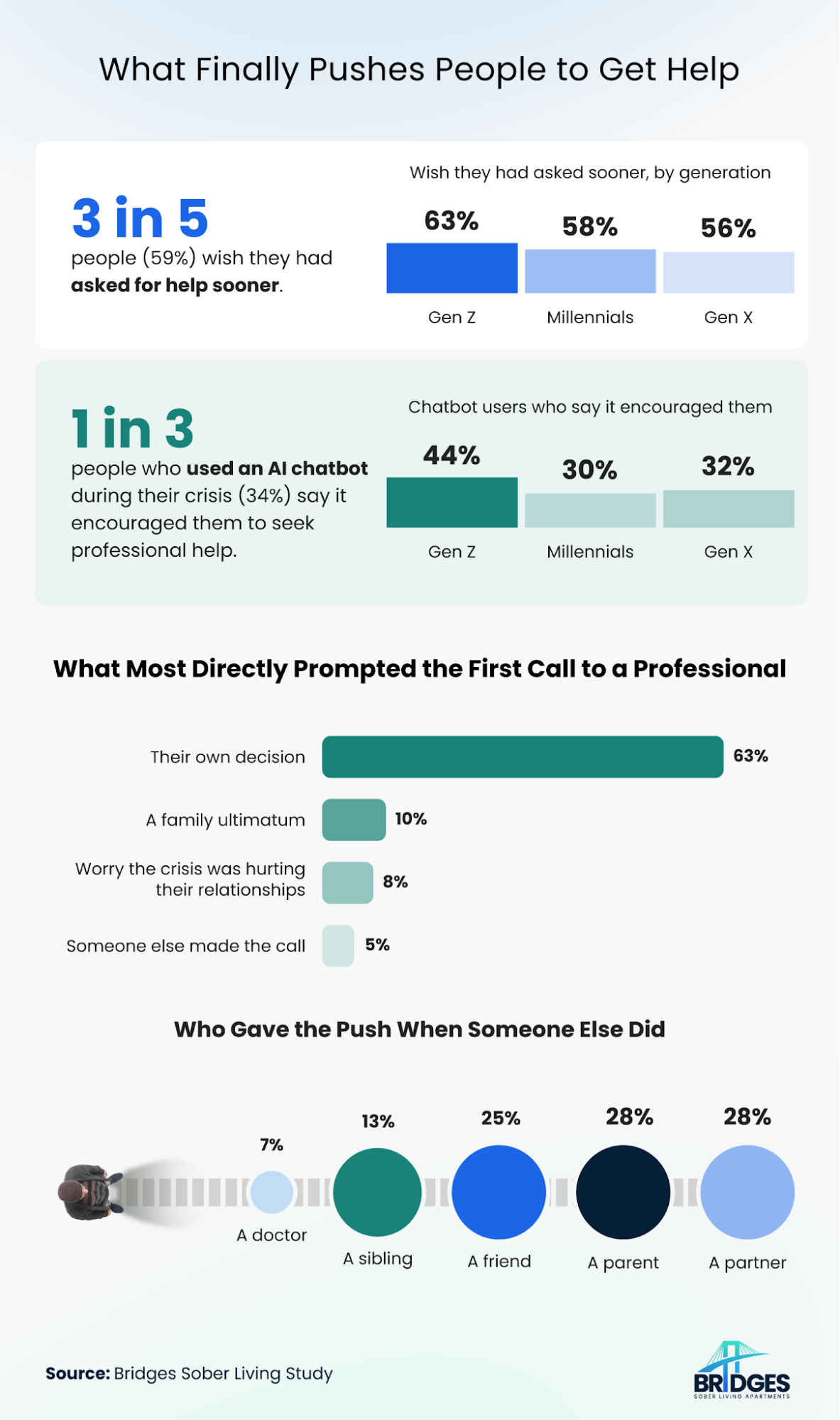
About 1 in 3 people who used an AI chatbot during their crisis (34%) say it encouraged them to seek professional help.
For most people, the hardest part comes before anyone else knows. Here's what was going on before they reached a crisis point, and where the road to care slowed down.
The wait starts early and stays quiet. The typical person who has lived through a mental health or substance use crisis waited about 4 months before telling anyone they were struggling, and about 1 in 4 (25%) waited a year or longer. Most people (90%) said they pretended they were fine when someone asked, before they ever said a word.
Men waited longest. The typical man's road to care ran about 18 months from first realizing something was wrong to starting care, compared with about 12 months for the typical woman. The single longest stretch for everyone fell between telling someone and calling a professional, where nearly half of people (47%) waited 6 months or longer, including 55% of men versus 44% of women.
People dealing with both substance use and a mental health condition waited even longer. More than half (54%) took 6 months or longer just to tell anyone, compared with about a third (34%) of those facing a mental health condition alone.
As for what set the crisis in motion, loneliness or isolation led the list at 46%, ahead of money problems (39%) and a relationship ending (35%). Loneliness weighed heaviest on the youngest respondents, cited by 58% of Gen Z, 46% of millennials, and 33% of Gen X. Men were twice as likely as women to point to job loss (14% vs. 7%) and more than twice as likely to name escalating substance use (16% vs. 7%).
We didn't ask people to rate their support. We asked them to count it, starting with a simple question: how many people could you have called in the middle of the night?
About 1 in 4 (24%) had no one they could have called in the middle of the night at the worst point of their crisis, including about a third of men (32%) and roughly 1 in 5 women (21%). Nearly half of everyone surveyed (46%) reached out to no one at all, a figure that climbed to 57% among men. The typical man reached out to no one; the typical woman reached out to one person.
That isolation tracked closely with how long people waited. People with no one to call in the middle of the night were the most likely to wait 6 months or longer before telling anyone (54%). Even having someone only helped if people used it: 47% who had someone to call but reached out to no one waited 6 months or more, compared with 30% of those who reached out to at least one person.
More than 1 in 4 (27%) said no one knew how bad things really were. About a third (36%) couldn't recall anyone asking how they were and waiting for a real answer, with these figures rising to 41% among men and 45% among those who never sought care.
For most people, they were the first to know. Nearly 2 in 3 (64%) said they noticed something was wrong in themselves before anyone else in their life did. A partner or spouse was the first other person to notice for 18% of men and 12% of women.
Relationship status also mattered. Single people (31%) were nearly twice as likely as married people (18%) to have no one they could have called, and divorced or separated people (41%) were the most likely to say no one knew how bad it was.
Something eventually tips the balance. For most people, it was their own decision, but for others, it took a nudge from someone or something else.
When people finally reached a professional, most say the decision was their own. About 3 in 5 (63%) called it their own choice, while just 1 in 20 (5%) said someone else made the call for them. Roughly 1 in 5 (19%) said something outside themselves pushed them, whether a family ultimatum (10%), someone else stepping in (5%), an arrest (3%), or a job consequence (2%), and men and women were about equally likely to say so (22% vs. 19%).
When someone else did give the push, it usually came from close to home, most often a partner (28%), parent (28%), or friend (25%). Men were more likely than women to name a parent (35% vs. 26%), and nearly 2 in 3 people (64%) said the person who nudged them was a woman. Looking back, 59% wish they had asked for help sooner, a feeling strongest among those who eventually entered care (66%) and among Gen Z (63%).
One newer influence stood out. About 1 in 3 people who used an AI chatbot during a crisis (34%) said it encouraged them to seek professional help. That share rose to 44% among Gen Z users, compared with 32% among Gen X and 30% among millennials.
Among the people who haven't entered care, about half (51%) said they thought they could handle it on their own, 2 in 5 (40%) couldn't afford it, and more than 1 in 4 (27%) were afraid of being judged.
Asking for help can feel like a big step, but it doesn’t have to happen all at once. If you’re struggling, starting with one trusted person can open the door to more support, whether that eventually means talking with a professional, finding a recovery community, or simply being more honest about what you’re going through. And if you’re concerned about someone you love, reaching out with patience and without judgment can remind them they don’t have to navigate a difficult time alone.
Bridges Sober Living surveyed 1,011 adults who have lived through a substance use or mental health crisis. The sample was 71% women, 24% men, 4% non-binary or gender-nonconforming, and 1% preferred not to say. By generation, 28% were Gen Z, 49% were millennials, 19% were Gen X, and 4% were baby boomers. Wait times are typical (median) figures estimated from the time ranges respondents chose. Percentages that do not total 100% are due to rounding.
Bridges Sober Living Apartments provides structured, apartment-style sober living in Los Angeles for individuals transitioning from treatment to independent living. Through one-on-one mentoring, accountability, and peer support, Bridges offers a recovery-focused community where residents can rebuild routines, strengthen life skills, and take the next step toward independence.
You are welcome to share these findings for noncommercial purposes. Please credit Bridges Sober Living Apartments and link back to this page so readers can view the full study and its methodology.
This study was conducted by Bridges Sober Living Apartments and is based on a survey of 1,011 adults who have lived through a substance use or mental health crisis. It was written by David Beasley, Program Director at Bridges, and reviewed by Sheldon Cohen, LMFT, a licensed marriage and family therapist with nearly a decade of experience supporting people through addiction and recovery.