Are you or a loved one searching for a trusted sober living program? Give us a call!  310-953-4075
310-953-4075 310-953-4075 Not every sober living home operates in the same way. Some are primarily peer-run, while others have house managers, paid staff, structured programming, or professional services.
The National Alliance for Recovery Residences (NARR) uses four levels to describe different types of recovery residences. The levels are based mainly on differences in staffing, governance, oversight, and recovery support services.
One resident in Los Angeles described wanting something different from a highly programmed environment:
“It feels way too much like rehab 2.0 with constant structure and classes and not much actual freedom like what was promised. Trying to find something that feels more like independent sober adult living instead of extended treatment.”
That concern is useful to keep in mind when comparing recovery residences. More structure is not automatically better for every person. The goal is to understand what each level provides and decide what type of living environment matches your current needs.
The four NARR levels range from peer-run homes to residences that provide professional services on site. They are not simply a ranking from “best” to “worst.” Instead, they describe different approaches to staffing, oversight, resident responsibility, and recovery support.
The level also does not tell you everything about a particular home. House rules, daily schedules, costs, services, and resident expectations can differ from one residence to another.
Level I residences are peer-run homes. Residents have a major role in managing the home and making decisions about how it operates.
The Oxford House model is a well-known example. NARR describes Level I residences as democratically governed, with residents sharing responsibility for the home and using peer accountability and house guidelines to support the community.
Level II residences add more oversight while still relying heavily on the peer community.
NARR describes Level II residences as monitored homes that use house rules and peer accountability. A senior resident or house manager may be appointed by the owner or operator to oversee the household. Some Level II homes may also provide recovery support or life-skills development, although at a lower intensity than Level III residences.
Level III residences provide a higher degree of staff involvement and organized support.
NARR describes Level III residences as having structured programming, recovery support services, and life-skills development. Staff are supervised, trained, or credentialed, and may include people with experience living in recovery residences themselves.
Programming may include areas such as recovery and resiliency groups, person-driven recovery plans, job readiness, or budgeting.
Level IV is the most service-oriented of the four NARR levels. NARR describes this model as combining the social model with professional staff and clinical services provided within the residence.
This makes Level IV different from residences where residents receive clinical services separately in the community.
The four levels differ mainly in how the residence is managed, how much oversight residents receive, and what recovery support is available.
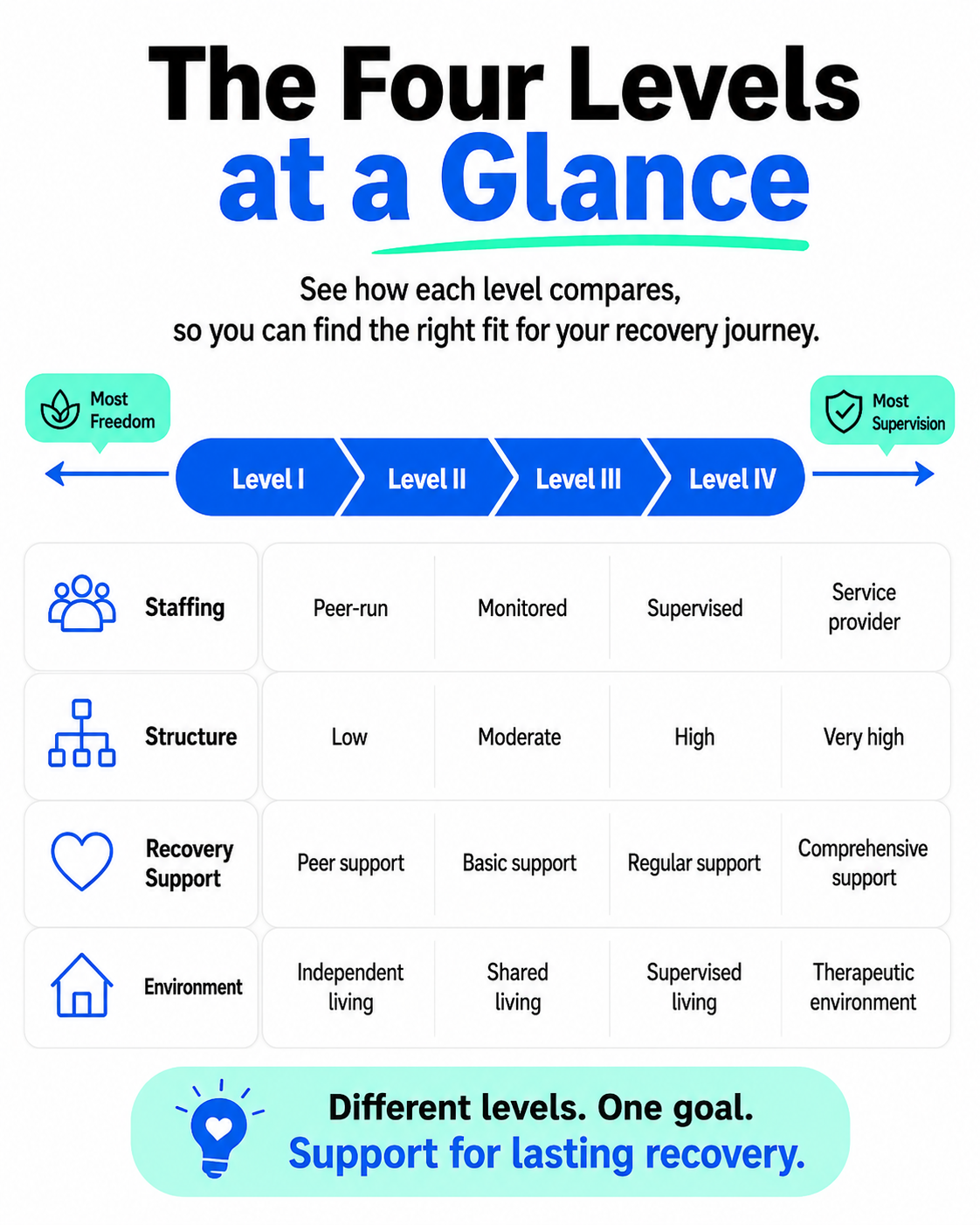
The four NARR levels provide a useful way to understand differences in staffing, oversight, and services, but they do not replace looking at what an individual residence actually offers. At Bridges, residents have access to a combination of house oversight, daily accountability, and programs that support everyday recovery.
Bridges includes house managers, house rules, structured programming, and life-skills development. Residents can also access services such as:
Rather than relying on a level alone, these features give a clearer picture of what residents can expect from the Bridges sober living environment.
More structure is not automatically the right choice for everyone.
Someone who is having difficulty managing daily responsibilities may appreciate more supervision, scheduled activities, and regular staff involvement.
Someone who is already comfortable managing work, appointments, routines, and personal responsibilities may prefer a living environment that leaves more room for those responsibilities.
This is why it helps to look beyond the level number.
Before choosing a residence, ask what a normal weekday looks like. Find out how much time residents have for work, exercise, meetings, appointments, errands, and personal activities. Ask which activities are required and which are optional.
You should also understand how house managers or staff interact with residents. A residence can have clear expectations without making every part of the day feel programmed.
The right amount of structure is the amount that gives you the support you need while still allowing you to practice handling everyday responsibilities.
The amount of support you need may change as you move through recovery. A residence that works well now may not provide the same fit later.
For example, someone who initially benefits from regular supervision may eventually feel ready to manage more of their daily responsibilities. Someone else may realize that additional oversight, programming, or recovery support services would be helpful.
Moving to a different level does not necessarily mean starting over. It may simply reflect a change in the amount of support that works for you at that point.
If you are considering a move, compare the staffing, house expectations, available services, and daily routines at the new residence before deciding.
The NARR level can give you a useful starting point, but it should not be the only factor you consider.
Before choosing a home, look at:
It is also worth asking whether the residence is certified through a NARR state affiliate or another recognized organization. NARR itself does not directly certify individual residences; certification is handled by its state affiliates.
Most importantly, compare the actual living environment with what you need right now. A residence that looks appealing on paper may not be the right choice if its daily expectations do not match your situation.
Understanding the four NARR levels can make it easier to compare different recovery residences, but the level alone does not tell you what daily life will be like.
Look at the home's rules, staffing, programming, services, and expectations before making a decision. Ask specific questions about what residents actually experience rather than relying only on a label.
Bridges offers a structured sober living environment with house managers, life-skills programming, house expectations, and additional support services for residents in Los Angeles.
A NARR Level II home is a monitored recovery residence. It typically has house rules and peer accountability, with a house manager or senior resident providing additional oversight. Some Level II homes may also provide recovery support or life-skills services.
No. The right amount of structure depends on what you need from your living environment. Some people may benefit from more supervision, while others may be ready for more responsibility and personal time.
Potentially, yes. A person's needs can change, and moving to a residence with more or less oversight may be appropriate. However, the process depends on the individual residences, their policies, availability, and your circumstances.
Level I residences are peer-run, with residents taking primary responsibility for managing the home. Level II residences add monitoring and have a house manager or senior resident providing additional oversight.
No. NARR levels are part of the recovery residence standards framework, but you should confirm whether a specific residence is affiliated with or certified through a NARR state affiliate rather than assuming it has a particular level.
Consider how much oversight, accountability, personal responsibility, and recovery support you want in your living environment. Ask each residence about its daily schedule, house rules, staffing, programming, and services before deciding.