Are you or a loved one searching for a trusted sober living program? Give us a call!  310-953-4075
310-953-4075 310-953-4075 If you are looking at PHP, IOP, or sober living in Los Angeles, the terminology can quickly become confusing. These options can be used at different recovery points, and sometimes more than one is used at the same time.
One person described this confusion after moving into sober living while attending PHP:
“I was told we would have therapy and activities from 9 to 3 but we really only do stuff from 10 to 1. Then we just go back to our sober living where everyone just stays in their room.”
That experience highlights an important point: clinical care and housing are not necessarily the same thing. Knowing what each provides can help you understand what your day may actually look like.
The names can sound similar, but each refers to something different.
| Option | What It Means | What It Provides |
| PHP | Partial Hospitalization Program | More intensive daytime clinical services |
| IOP | Intensive Outpatient Program | Several hours of clinical services each week |
| OP | Outpatient Care | Scheduled counseling, therapy, or other services |
| Sober Living | A recovery-focused living environment | Housing, house expectations, accountability, and community |
PHP, IOP, and OP describe clinical services. Sober living describes where you live.
That means you can attend an IOP while living in sober living, but the IOP and the residence may be separate organizations with separate policies and costs.
For example, your IOP may determine when you attend groups and appointments. Your sober living home may determine house expectations, curfew, chores, and other parts of daily life.
A 2022 study examined how recovery housing and outpatient services can work together. It found that living in structured recovery housing was associated with longer outpatient stays and greater odds of a satisfactory discharge. The researchers also identified accountability, recovery skills, and social support as important reasons participants valued the living environment.
This distinction is important when comparing costs, schedules, and responsibilities. Ask who provides each service, what each one costs, and what is included.
These options do not always follow one fixed path. A person's care may change as their needs change.
One possible progression is:
Detox → Residential care → PHP → IOP → OP
Sober living can overlap with outpatient care, including PHP or IOP, when someone wants a recovery-focused place to live while receiving clinical services elsewhere.
For example, someone may attend PHP during the day and return to sober living afterward. Later, they may move to IOP, giving them more time for work, appointments, meetings, or other responsibilities.
The timing is not the same for everyone. The appropriate level of care depends on the person's needs and recommendations from their care team.
Your schedule will depend on your IOP, work schedule, transportation, house expectations, and other responsibilities.
A typical day might include:
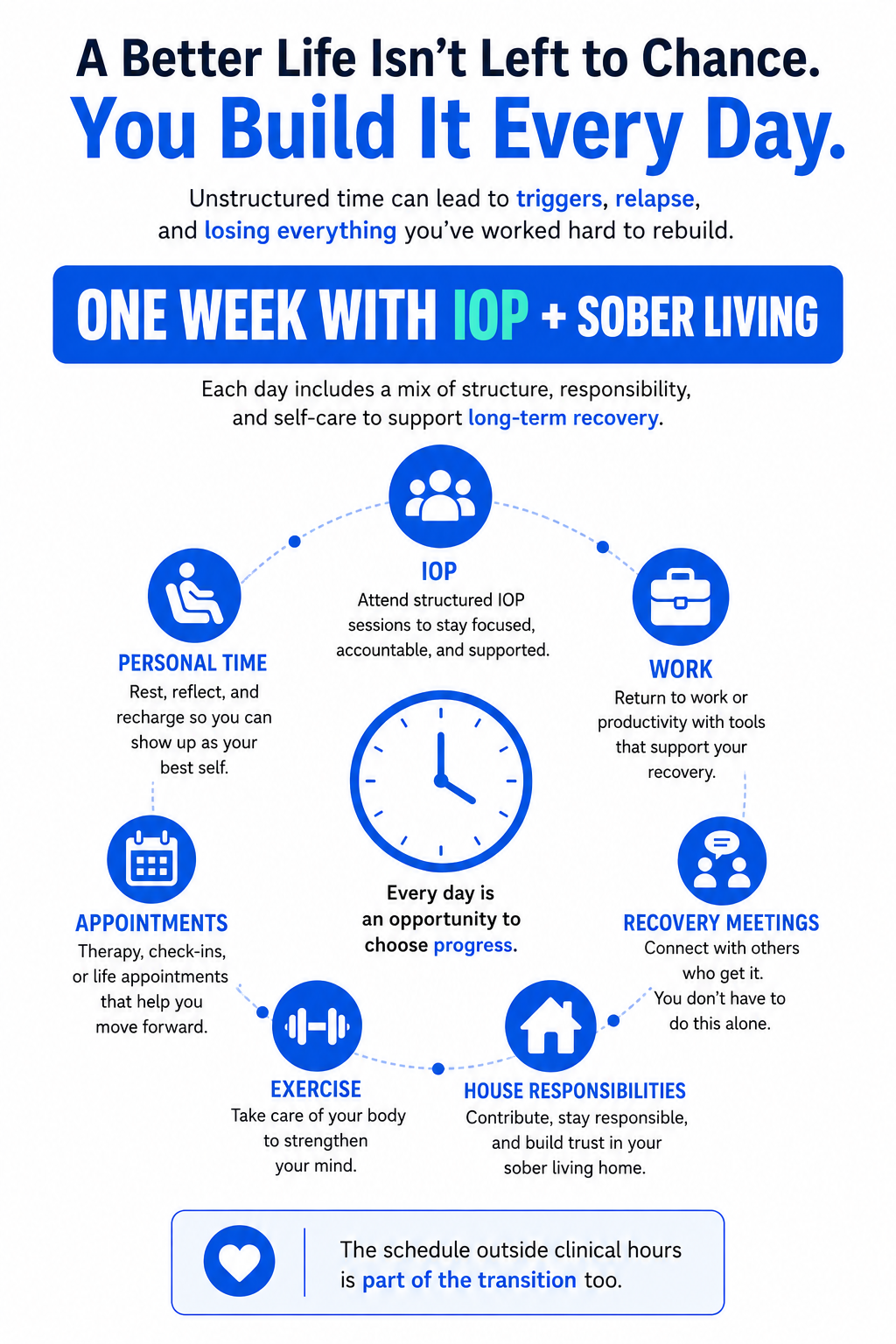
The time between your last group and your evening house expectations can look different from day to day.
You might use that time for work, exercise, a recovery meeting, an appointment, grocery shopping, one-on-one mentoring, or time with supportive people.
Having a simple plan can also make the transition from PHP or IOP back to the residence easier. The goal is not to fill every hour. It is to have enough routine and meaningful activities that your day does not suddenly stop when your clinical schedule ends.
If you are planning to attend outpatient programs while living in sober housing, look at the two arrangements separately.
Consider:
You can also ask whether the IOP has experience working with people who live in sober housing. This can help you understand how the two schedules may work together.
Finishing outpatient treatment doesn’t necessarily mean you are ready to leave sober living. In many cases, the end of scheduled clinical treatment is when the structure of your living environment becomes even more important.
Sober living gives you a place to continue practicing what you have learned outside of those treatment hours. Depending on the residence, recovery support services can also help you continue building routines and managing everyday responsibilities as your schedule changes.
That can create an important transition period. Instead of going directly from structured treatment to living completely on your own, you can continue building the routines that support long-term recovery while working, attending meetings, managing your finances, and handling everyday responsibilities.
Research on recovery housing also suggests that the living environment can continue to play a role beyond scheduled outpatient services.
Your next step might be continuing to live in sober housing while you establish greater independence. You may eventually transition to another living arrangement when you feel prepared and have the stability to manage it.
PHP, IOP, and OP provide different levels of clinical care, while sober living provides a place to live with its own expectations and community.
Using both can give you clinical support during the day and a recovery-focused living environment outside program hours. The two do not have to be provided by the same organization.
For people looking for sober living in Los Angeles, Bridges offers a recovery-focused living environment where residents can continue working, building routines, and taking part in their ongoing recovery while living in a supportive community.
Yes. IOP and sober living can be used together. The IOP provides clinical services, while the sober living home provides the living environment and its own house expectations.
Usually, insurance coverage for clinical services and payment for sober living are separate. Ask both your insurance provider and the residence what costs apply to you.
You may be able to continue living in sober housing after IOP ends, depending on the residence's policies and your individual circumstances. Ask the home about its length-of-stay expectations before you move in.
Often, yes. IOP schedules can leave time for employment, although the amount of available time depends on the program and your other responsibilities.
No. PHP generally provides more intensive outpatient services and more program hours than IOP. Both are outpatient levels of care, but they are not the same level.
Yes. Sober living and outpatient treatment can be used together. Outpatient care provides clinical services, while sober living provides housing, accountability, and community.